
Insights in our cultural differences
TL;DR
Cultural differences in nearshore outsourcing teams are a strength rather than a challenge. By understanding national and organizational cultures using Hofstede’s six cultural dimensions, cross-border collaboration becomes more effective. In this article we compare our locations the Netherlands, Portugal, and Ukraine.
The Netherlands is individualistic, low in hierarchy, and values work-life balance, while Portugal and Ukraine are more hierarchical and collectivist, emphasizing loyalty and teamwork. All three cultures value structure, involvement in decision-making, and security. Leveraging these differences helps create stronger, more diverse teams.
Introduction
Working with an outsourcing nearshore team means that you gain cultural diversity within your company. Many companies feel like cultural diversity brings challenges even though cultural diversity strengthens an organization. Becoming aware of the differences might be helpful to work more successfully across borders. And you might find that the differences are not as significant as you thought. To help you use these differences to your advantage, we will try to help you gain insight into the interculturalism between the countries that we operate in. In our case this means comparing Portugal and Ukraine with the Netherlands.
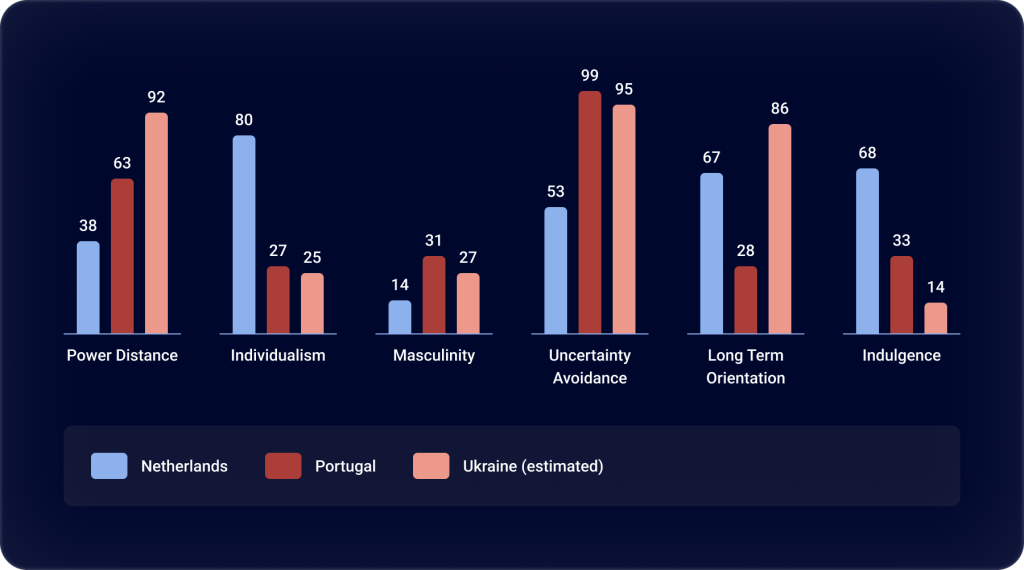
First of all, when discussing culture, we can speak of organizational and national cultures. Separating these is hard since there is a lot of overlap between them. National Culture must be considered when defining your Organizational Culture. Organizational culture is something you specify within your company and is crucial for managing diverse teams. Your company’s members, however, make up your organizational culture daily. Knowing more about the different national cultures helps you see what each team member brings to your team and how they influence your organizational culture. To make this National culture insightful, we look at the six dimensions of Hofstede. His theory was developed to compare the underlying motivations of culture with other cultures worldwide.
Power Distance and Individualism
The Netherlands scored low on power distance and high on individualism. Power distance refers to the degree to which less powerful members within a culture expect and accept that power is distributed unequally. Individualism indicates the extent of interdependence that a society upholds. The Dutch have a soft feeling of hierarchy and a self-image defined in terms of ‘’I’’ rather than ‘’We’’.
Working with colleagues in Portugal and Ukraine will grant you, great team players. With a high score on power distance, they accept a hierarchical order in which everybody has a place. Furthermore collectivist societies foster strong relationships where everyone takes responsibility and protect fellow group members. Loyalty is conceived as necessary and overrides most other societal rules. This combinations makes that within these cultures the team or group is the seen as most important.
Masculinity
Societies that score high on the masculinity dimension will be driven by competition, achievement and success, wanting to be the best in the field. Low-scoring communities are driven by caring for others and quality of life. It shows whether people are motivated by wanting to be the best or liking what they do. Often a high score on masculinity often goes together with a high score on powerdistance. Ukraine however is an exception in on this with a high score on power distance but a low score on masculinity. These seem to contradict each other, but it can be explained by the humble way of talking about themselves and a generally modest standard of living. In all three countries striving for consensus and making decisions by involvement are essential. The Netherlands has the lowest score which can be explained by the big emphasis on work/life balance and its own ‘’polderpolitiek’’ for reaching a consensus after lengthy discussions.
Uncertainty avoidance
No one knows what the future will bring. You can either try to control it or just let it happen. Choosing how to react to this uncertainty brings anxiety with it. Within different cultures, we have found different ways of dealing with this. This dimension shows how cultural members create beliefs and institutions to deal with this anxiety. All three countries score high on this dimension meaning that these societies feel a need for rules. Members of these cultures have the urge to be busy and work hard. Precision and punctuality are the norms, and a sense of security is important in individual motivation.
Long Term Orientation
This dimension describes how people deal with the things around them that cannot be explained. Societies with low scores have a normative orientation and a strong tendency to explain as much as possible. Portugal is the only normative culture. Leading to a great value for traditions and the urge to achieve quick results. The other countries with high scores have a pragmatic orientation. They don’t believe that it’s possible to grasp the complexity of life fully and therefore have no urge to explain everything. They believe that the truth depends on the situation, context and time. Leaving them focused on the long run, looking to save and invest.
Indulgence
Indulgence is all about our ability to control our desires and impulses. The Dutch stand out with a high score, meaning they are raised to enjoy life and have fun. They willingly give in to their desires and impulses. This corresponds with the masculinity score, where we see a great need for work/life balance. Bosnia Herzegovina has no strong preference, but Portugal and Ukraine tend to restrain. This means they perceive their actions as controlled by social norms and feel that indulging themselves is somewhat wrong.
Conclusion
Hofstede’s six cultural dimensions represent independent preferences that distinguish countries rather than individuals. Everybody has individual preferences, but understanding one national culture can be helpful. It grants insight into these preferences, often based on their upbringing. Combining different preferences helps you build a more robust and diverse team. If you want to know more about organizational and national cultures, you can look at the https://www.hofstede-insights.com/ .
Expert

SharpMinds team
Thinking about hiring remote developers?
Let's plan a meeting!
Let's plan a meeting!
"*" indicates required fields
Lennaert Groen
🇳🇱 Co-Owner SharpMinds
“I’d be delighted to tell you more about our approach!”